
What Your Final Drive Oil Is Trying to Tell You
Posted by Jim Strong on Sep 21st 2026
Pull the drain plug on a final drive motor, and you learn a lot in about ten seconds. The color. The smell. Whether anything shiny comes out with it. Gear oil is the cheapest diagnostic tool you own, and most people only read it after something has already gone wrong.

Here's how to read it, what each sign usually means, and what to do next. This Shop Talk Blog post covers how to read your final drive gear oil and what to do with the results.
Quick guide to what you're seeing
If you're staring at a drain pan right now, start with this table.
Why is my final drive oil milky?
Milky gear oil means water. It gets in through a worn seal, a pressure washer aimed too close to the hub, or condensation on a machine that heats up and cools down day after day. Once it's mixed in, the oil can't hold a proper film between the gear teeth, and the bearings start rusting almost right away.
Changing the oil is the easy part. The real job is finding out how the water got there. If a seal is failing, fresh oil buys you a few weeks at best. While you're in there, look at the main hub seal, the one between the sprocket and the track frame. If oil is weeping from that area, or if you see oil on the sprocket or track, it means the machine shouldn't go back to work until someone has looked at it. And keep the pressure washer wand back from the hub and the plugs.
Is metal in the gear oil a big deal?
Yes, it is. Flakes, slivers, or a metallic shimmer in the drained oil or stuck to the magnetic plug point to a bearing that's starting to fail, or gear teeth and splines wearing fast. This is the one sign you don't ignore. A bearing that breaks up sends pieces through the rest of the planetary hub, and a bearing job turns into a whole-drive problem. Caught early, it can be a simple bearing swap. Caught late, you're replacing the final drive.
What if the oil is dark, thick, and smells burnt?
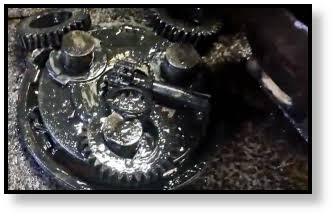
That oil has been in there too long. Heat and load break it down until it does more harm than good. We sometimes refer to that kind of gear oil as pudding. The fix is boring: drain it, look at what comes out, refill. Then put the next change on the calendar. Oh, and don't confuse this with the sulfur smell of fresh EP gear oil. That one's normal.
Can I mix oils, or use grease in a pinch?
Grease, no. Your drive was built for gear oil, and grease can't circulate like oil. If a leak has emptied the hub and you can't get it in the shop yet, parking the machine is a better plan than packing the hub with grease.
Mixing oils is a no as well. Two oils with the same viscosity grade can still carry different additive packages, and there's no guarantee they get along. Always top off with the same oil that's already in there. And if you don't know what's in there, do a full drain and refill instead of guessing.
Which gear oil goes in a final drive?
You should use whatever the manufacturer specifies. That's the one rule that doesn't bend. Let’s say you have a Bobcat A300: Bobcat’s skid steer oil is SAE 80W-90 premium extreme pressure gear lubricant.
For planetary final drives in general, it's usually an 80W-90 gear oil with EP (extreme pressure) additives, which protect the gear teeth when the load spikes. Too thin, and the film gives out under load. Too thick and it doesn't reach the bearings the way it should. Check the operator's manual for your make and model, and if you can't find it, call us.
If you need a fill, our excavator gear oil is made for final drives and travel motors, with additives for high-heat work. It's listed for Kubota, Caterpillar, Bobcat, Volvo, John Deere, and Hitachi units, and it comes in a bag, which makes it easier to keep dirt out of the fill hole. Confirm it against your machine's spec before you order.
How do I check and change the oil?
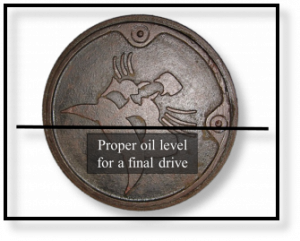
Here’s the short version: position the drive so one plug sits at 12 o'clock and the other at 3 or 9 o'clock. Clean around both plugs first, then pull them. If the level is right, oil sits even with the side opening. If it's low, add oil through the top hole until it runs out of the side one.
To change it, drain while the oil is warm, using the 6 o'clock plug for draining and the side plug as a vent. Fill it the same way you'd top off.
That's the outline. The full walkthrough is in our guide to checking and changing the oil in a final drive, so read it before your first one.
If you've just installed a replacement or rebuilt drive, ask whoever supplied it whether they want an early first oil change, and check the level after the first few hours of work.
Quick answers
More of the basics are in our Gear Oil Questions Answered post. Here are three that come up constantly:
How often should I check the level?
A good rule of thumb is about every 100 operating hours or once a month. Now, if you're topping off nearly every time, it’s time to check the seal for a leak. However, we always encourage you to check your manufacturer’s guidelines.
How often should I change the oil?
At least once a year. Gear oil “wears out” over time, and that can be accelerated by loads and heat. Expired gear oil is going to do your final drive more harm than good.
Is the sulfur smell normal?
In fresh EP gear oil, yes. It's the additives. Dark, thick, and burnt is a different story.
Not sure what your oil is telling you?
Call us at 281-259-5267. Tell us the machine, the hours, and what came out of the drain plug. If the answer turns out to be a drive that's past saving, we rebuild and sell replacements, so you'll only need one call.